Research
I study how humans and LLMs represent and process language, and more broadly how they organize their higher-level cognitive systems. I treat large language models both as tools for cognitive science to understand the human mind, and as scientific objects in their own right. Below is an overview of the main threads with pointers to the papers.
Higher-level cognition in models and humans
Language is no longer all LLMs can do: the most advanced systems now solve problems in arithmetic and logic, write and debug code, draw analogies, predict the behavior of physical systems, and reason about other people's beliefs and intentions. Much of my current work studies these higher-level cognitive abilities in parallel between LLMs and humans.
The cost of thinking
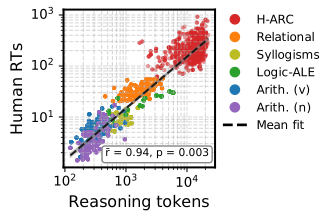
We compared humans and large reasoning models across seven reasoning tasks (arithmetic, logic, relational reasoning, and more). The length of the chain of thought generated by the models predicts human reaction times both within tasks, tracking item-level difficulty, and across tasks, capturing broader differences in cognitive demands. Reasoning models thus reflect core features of problem and task complexity in human cognition. The paper prompted three letters in PNAS, with our replies; the exchange is collected on the publications page. (The cost of thinking is similar between large reasoning models and humans, PNAS, 2025 · MIT News)
A modular cognitive architecture in language models
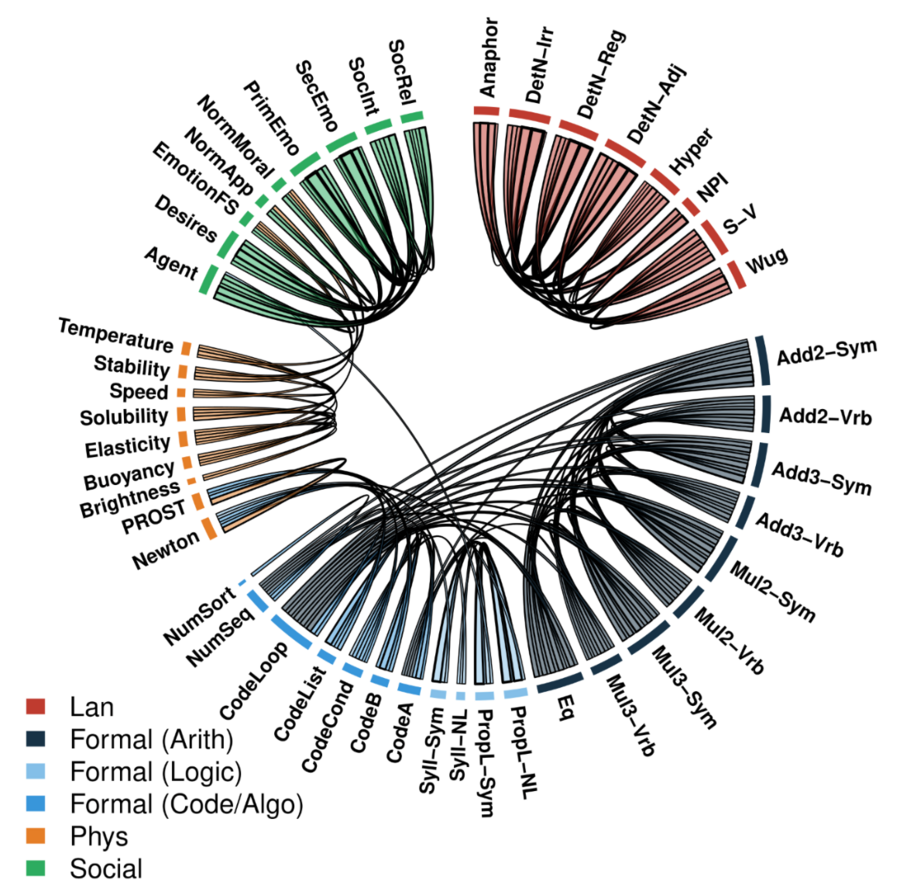
The human brain shows striking functional specialization, with distinct networks for language, formal reasoning, reasoning about other minds, and reasoning about the physical world. Is this modularity a general principle of intelligent systems, or an accident of biology? Using circuit analyses across 46 tasks spanning these four domains, we found that LLMs develop a modular organization that mirrors the brain: tasks that draw on the same network in humans recruit overlapping units in the models, whereas tasks that draw on different networks recruit distinct units. (Modular cognitive architecture emerges in large language models, arXiv, 2026)
Language in the brain and in models
I use language models to study human language processing, as reflected in behavior (reading times) and brain responses. Whenever possible, I try to study multiple languages, to support broader claims about the human language system (vs. English specifically).
Brain–model alignment across 21 languages
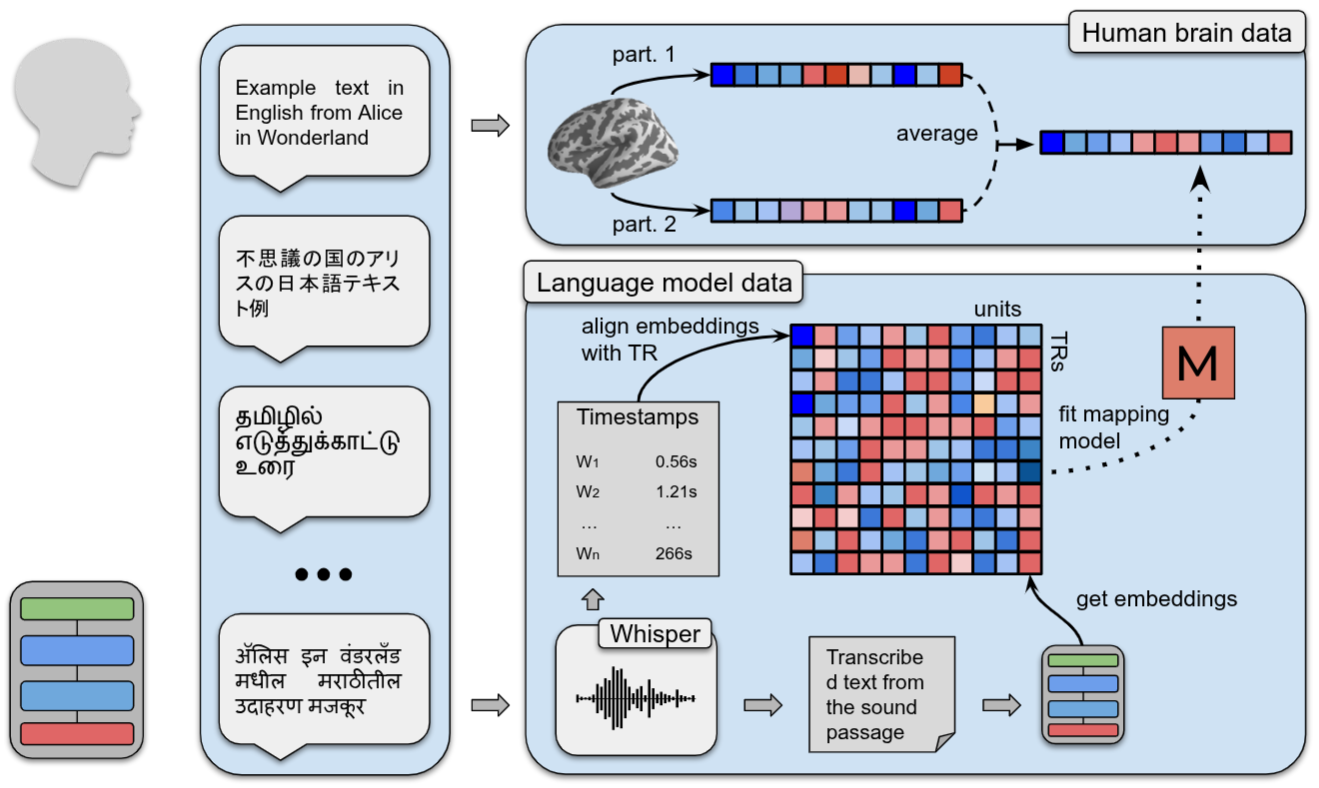
Using fMRI data from speakers of 21 languages across several language families, we trained encoding models to predict responses in the language network from multilingual model representations. The models predict brain responses within each language and, critically, can be transferred zero-shot to new languages: a model trained on one set of languages accounts for responses in a held-out language. This points to a shared cross-lingual component in brain responses that appears to be tied to meaning. (Multilingual computational models capture a shared meaning component in brain responses across 21 languages, bioRxiv, 2025)
What do brain and behavior tell us about language processing?
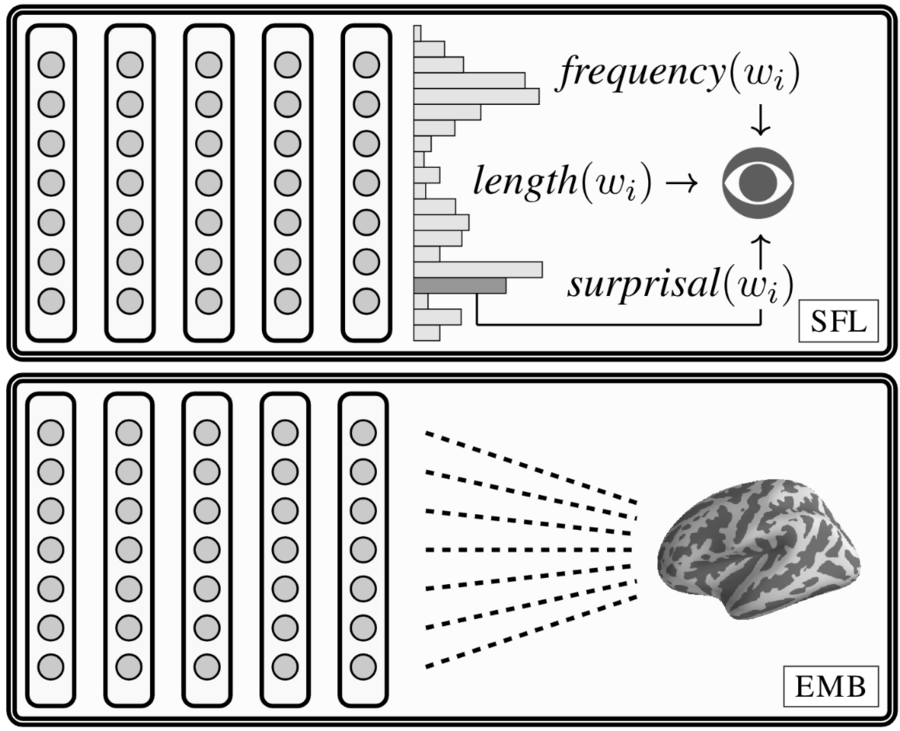
Do reading times and brain responses reflect sensitivity to the same information? Across 8 behavioral and 5 neural datasets (fMRI and ERP), effort-based predictors such as surprisal, frequency, and length capture substantial variance in both. But for brain responses, and not for behavior, high-dimensional embedding representations carried substantial predictive power beyond processing effort. Neural data give access to rich, high-dimensional dynamics of comprehension, whereas behavior reflects a bottleneck of those dynamics into a few theoretically motivated properties of the input. (Behavioral and brain responses to language reflect different levels of linguistic representation, bioRxiv, 2026)
Predictability and reading across languages
I study the effects of predictability on eye-tracking and reading behavior across languages, including non-native reading. I am particularly interested in how model scale relates to different stages of processing (early vs. late fixation measures), in the interplay between memory limitations and prediction, and in which architectural biases make a model a better fit to human reading times. (Scaling in cognitive modelling, ACL 2023, Outstanding Paper Award · The effects of surprisal across languages, Findings of AACL 2022 · Locally biased transformers, CMCL 2024 · Cloze probability, predictability ratings, and computational estimates for 205 English sentences, Behavior Research Methods, 2024)
Inside multilingual models
Multilingual language models encode knowledge of many languages, often hundreds, in a shared set of parameters. Multilingual LLMs let us ask what is shared across languages at different levels of analysis. They also help counter the English-centric bias of both NLP and cognitive science. My PhD thesis used multilingual LLMs to study cross-lingual language representations and processing.
Shared units for syntax and semantics
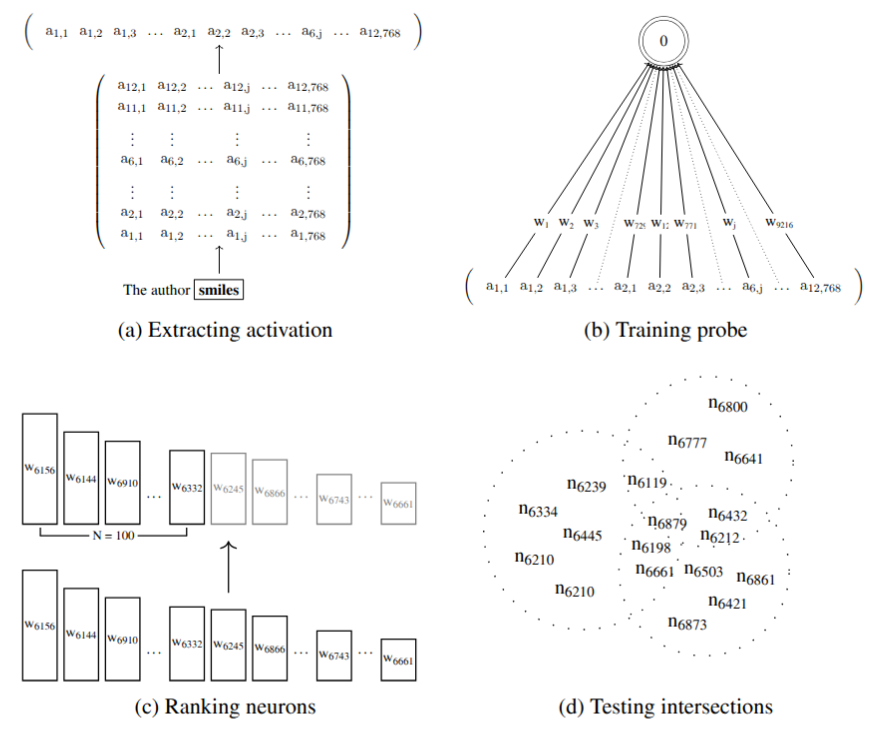
I analyze how multilingual models encode linguistic information, testing whether the same components support syntactic agreement and affective semantics across languages. Several studies converge on the idea that these models represent the same phenomena in a consistent way across languages. (Data-driven cross-lingual syntax, Computational Linguistics, 2023 · The emergence of semantic units in massively multilingual models, LREC-COLING 2024 · Different types of syntactic agreement recruit the same units within LLMs, ACL 2026)
Non-arbitrariness and iconicity
Language is not fully arbitrary. My work examines systematic links between word sounds and word meanings combining computational tools, behavioral data, and cross-lingual analyses.
Cross-lingual phonosemantic correspondences
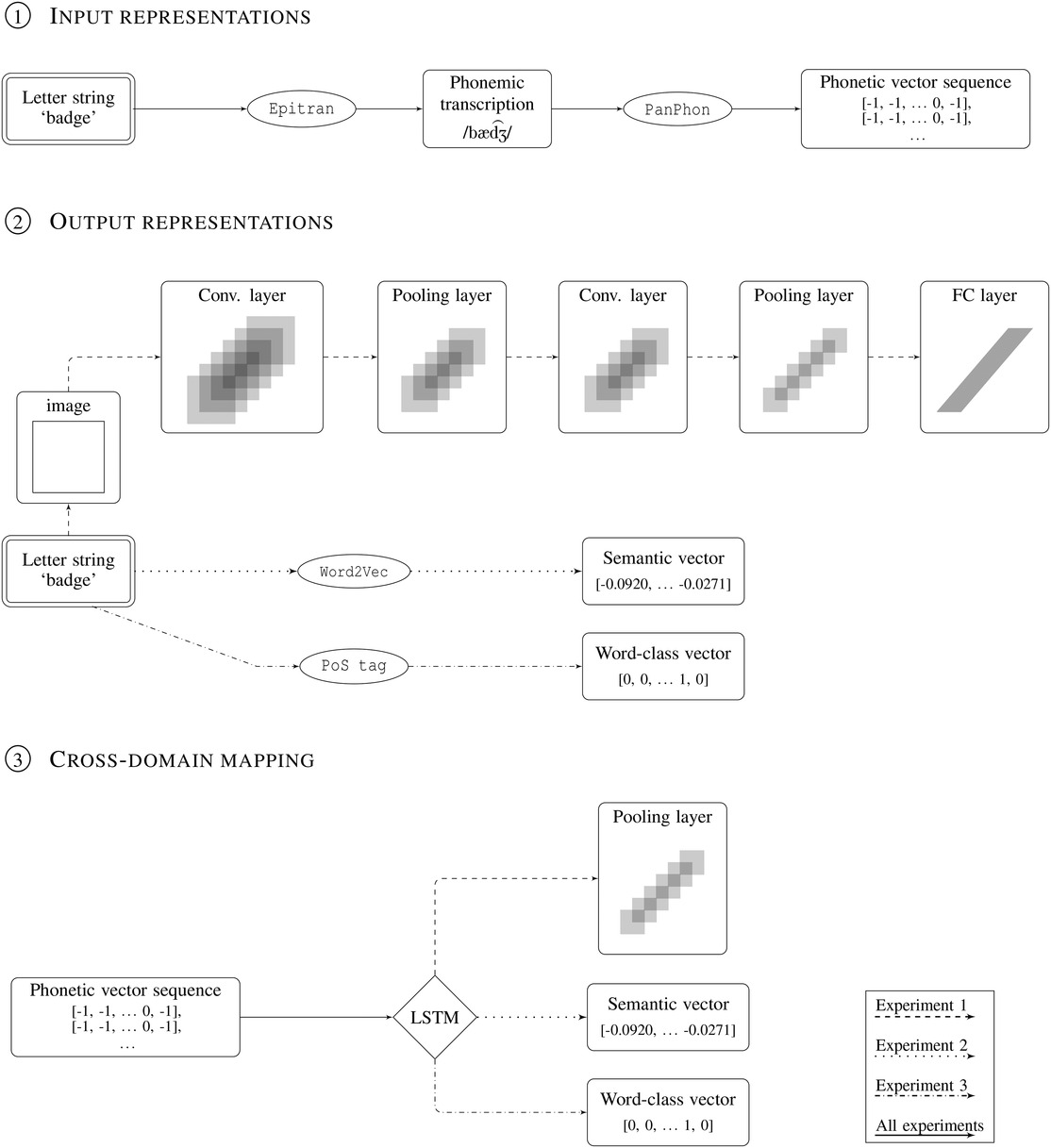
We train sequence models to map phonetic representations onto sensory, semantic, and word-class representations across typologically distant languages, and test zero-shot transfer (train the sound-to-meaning mapping in, say, English, then test in Tamil). Perhaps surprisingly, this works, indicating that there are cues linking form to meaning/syntactic class that are invariant across languages. (A cross-modal and cross-lingual study of iconicity in language, Cognitive Science, 2022 · Phonovisual biases in language, IJCAI 2021)
Auditory iconicity at scale
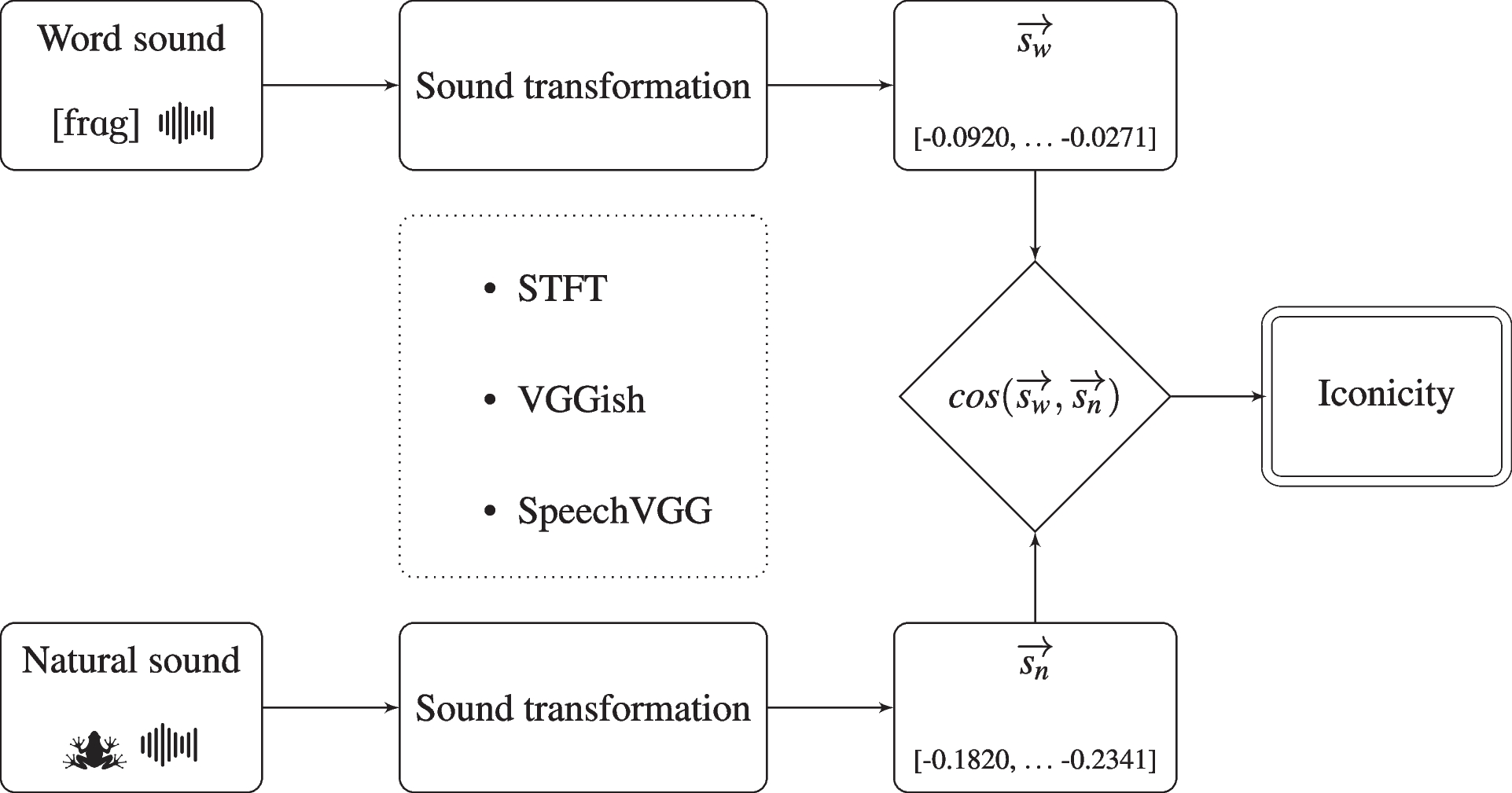
We embed natural sounds and spoken words into a shared auditory space (spectrograms, CNNs for sound and speech classification) to quantify direct resemblance between word sounds (the word "frog", /fɹɑɡ/) and natural sounds (a frog croaking). Auditory imitation is widespread across the English auditory vocabulary and aligns with human iconicity judgments. With colleagues in Bologna, we also released IconicITA, the first dataset of iconicity ratings for Italian, collected from both native and second-language speakers. (Cracking arbitrariness, Psychonomic Bulletin & Review, 2025 · IconicITA, PLOS One, 2025)
Meaning from experience
Grounding concepts in the spatial organization of objects
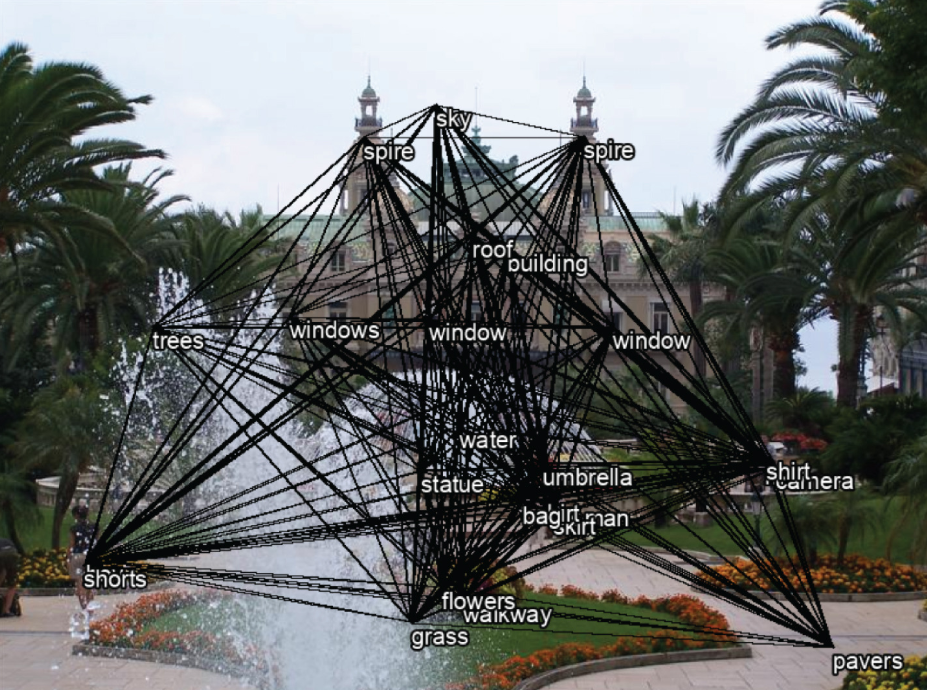
We introduced SemanticScape, a distributional model of concepts grounded in the spatial relations between objects in natural images. The model learns from object–object distances to capture semantic similarity, relatedness, and analogical structure, explaining variance in human judgments beyond text- and vision-based representations. (A distributional model of concepts grounded in the spatial organization of objects, Journal of Memory and Language, 2025 · Learning meaning from latent patterns in language use, Nature Reviews Psychology, 2025)
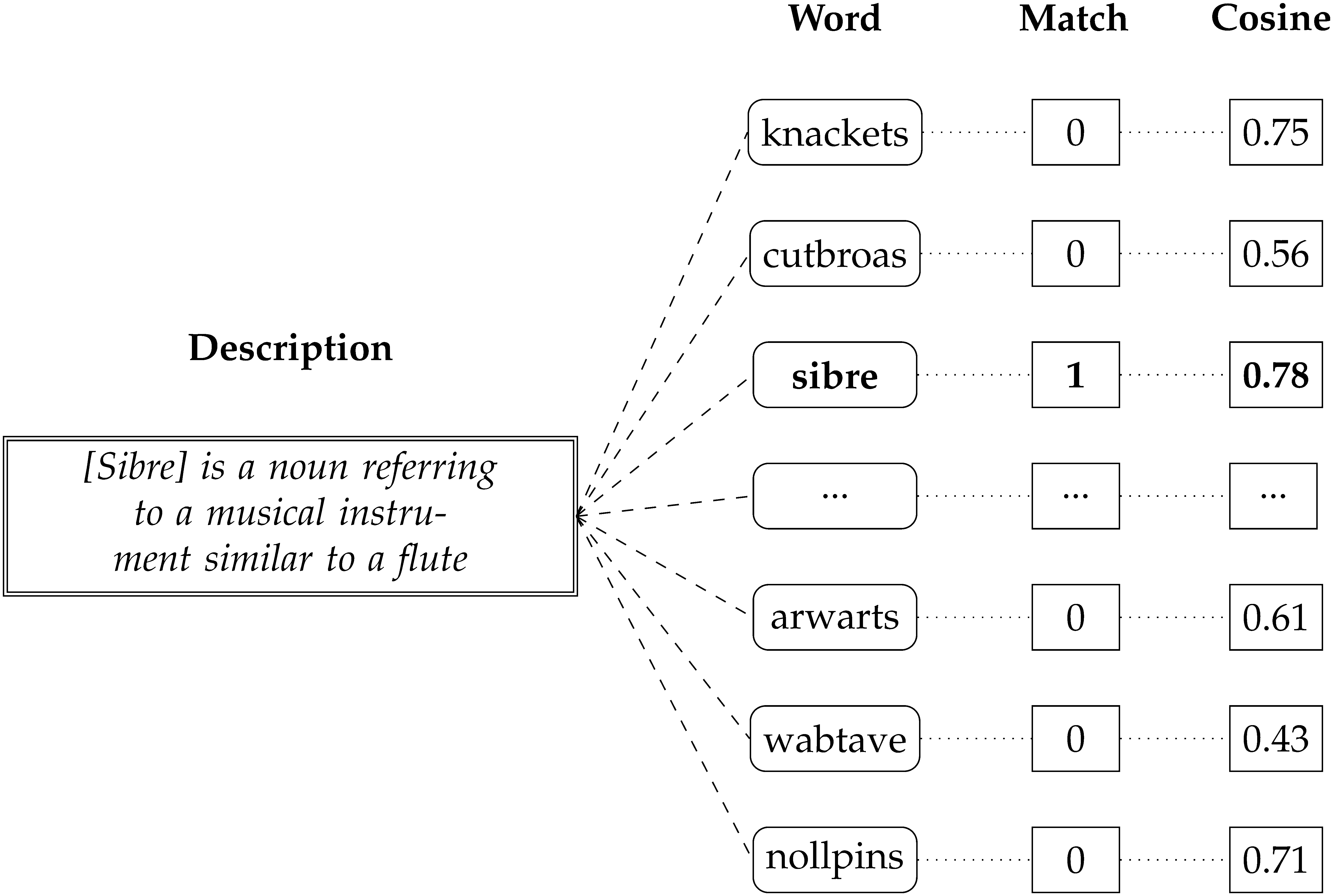
Meaning beyond lexicality
We tested whether people (and language models) can attribute explicit (declarative) meanings to novel word forms. Both human definitions and model representations show systematic form-to-meaning mappings, supporting a flexible generalization mechanism that extends beyond the lexicon. (Meaning beyond lexicality, Computational Linguistics, 2024)
For full citations, abstracts, and links to journals and PDFs, see the Publications page.